

Animal Feed Additives Market to Reach USD 116.3 Billion by 2036 as Demand for Antibiotic-Free Nutrition Accelerates
Animal Feed Additives
Animal Feed Additives Market Growth Accelerates as Industry Shifts from Antibiotics, Adopts Protein-Rich Diets, Phytogenics, and Probiotics
DELAWARE, NY, UNITED STATES, March 27, 2026 /EINPresswire.com/ -- The global animal feed additives market is witnessing strong growth as livestock producers increasingly focus on feed efficiency, herd health, and sustainable production practices. Rising consumer demand for antibiotic-free meat, eggs, and dairy products is accelerating the adoption of natural feed additives across poultry, swine, ruminant, and aquaculture sectors.
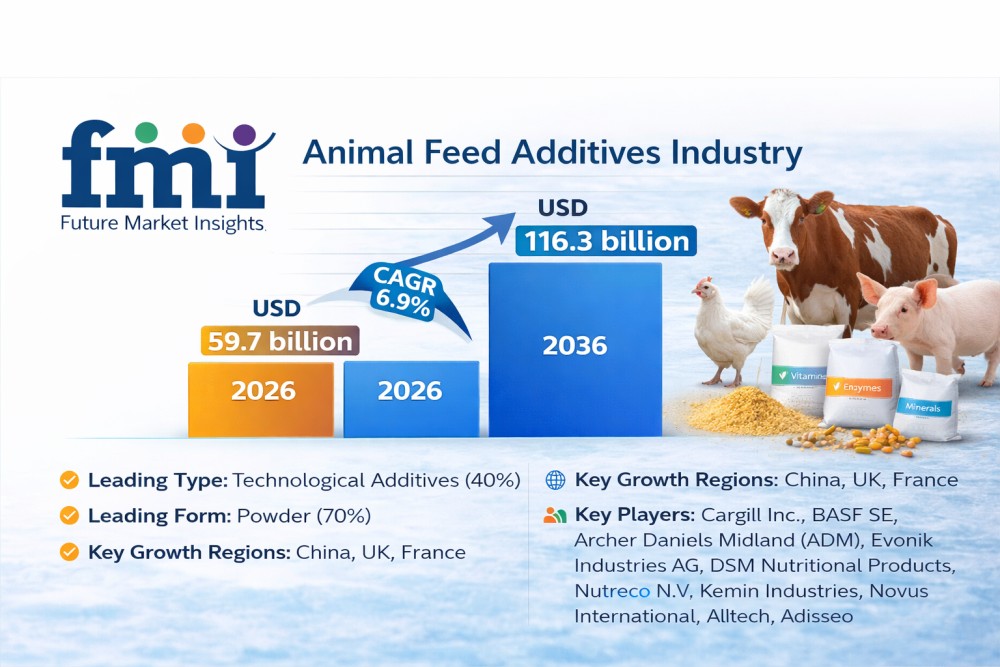
According to a comprehensive strategic outlook released by Future Market Insights (FMI), the global Animal Feed Additives Market is projected to grow from USD 59.7 Billion in 2026 to USD 116.3 Billion by 2036, reflecting a CAGR of 6.9%. The market is expected to generate substantial growth opportunities supported by the global ban on antibiotic growth promoters (AGPs), increasing feed conversion requirements, and expanding use of enzymes, probiotics, and phytogenic additives.
Get Access to the Full Report Sample: https://www.futuremarketinsights.com/reports/sample/rep-gb-418
The Evolution of Animal Feed Additives into a Critical Livestock Input
Animal feed additives have become essential for improving feed quality, animal performance, disease resistance, and nutrient absorption. The market includes a wide range of products such as technological additives, nutritional additives, sensory additives, enzymes, amino acids, probiotics, vitamins, minerals, and preservatives.
Growth is increasingly driven by the transition toward natural and antibiotic-free livestock production systems. Manufacturers are investing in phytogenics, probiotics, and encapsulated ingredients to enhance gut health and improve feed conversion ratios without relying on antibiotic growth promoters.
Supply Chain and Logistics Challenges Influencing Market Growth
Distribution and logistics continue to play a crucial role in market expansion. While powder-based additives dominate due to ease of handling and storage, liquid additives such as enzymes, acids, methionine, and lysine require specialized transport systems.
The transport of liquid feed additives depends on Intermediate Bulk Container (IBC) logistics and temperature-controlled supply chains to preserve biological activity and prevent leakage or degradation. FMI estimates that managing these cold chains adds nearly 10% to logistics overheads.
Key Market Insights for Decision Makers
Steady Growth Trajectory: Market expected to expand at a CAGR of 6.9% through 2036
Industry Value: Market projected to grow from USD 59.7 Billion in 2026 to USD 116.3 Billion by 2036
Leading Additive Type: Technological additives dominate with a 40% share in 2026
Leading Form: Powder additives account for 70% of market share due to handling and storage advantages
Natural Alternatives: Growing demand for phytogenics, probiotics, and enzymes as antibiotic substitutes
Logistics Impact: Cold chain management for liquid additives adds around 10% to logistics costs
Operational Metrics Driving Profitability
Operational efficiency remains critical for feed additive manufacturers. Compliance with regulatory bodies such as EFSA and the FDA is essential, especially for medicated and specialty additives.
Compliance Rate: Maintaining a 100% compliance rate is crucial to avoid recalls, fines, and manufacturing suspensions
Safety Incident Rate: Closed-loop dosing systems and PPE protocols are necessary to minimize risks associated with concentrated acids and minerals
Cost of Goods Sold (COGS): Production costs are heavily influenced by fermentation yields, grain prices, and access to corn, soy, and petrochemical substrates
Regional Dynamics: Emerging and Mature Markets
The animal feed additives market demonstrates varied growth patterns across regions:
China (6.3% CAGR): Growth driven by swine and poultry sector consolidation and rising demand for amino acids
UK (4.4% CAGR): Strong focus on sustainable livestock production and methane reduction
France (4.3% CAGR): Expansion supported by demand for natural and antibiotic-free additives
Japan (4.1% CAGR): Growth fueled by specialized aquaculture feed additives and automated feeding systems
USA (3.8% CAGR): Mature market focused on maximizing production efficiency and feed conversion ratios
Emerging economies continue to drive volume growth, while developed markets are prioritizing sustainability, precision nutrition, and premium feed solutions.
The Competitive Edge: Innovation and Product Diversification
The competitive landscape of the animal feed additives market is defined by innovation, microbiome research, and strategic partnerships. Leading manufacturers are focusing on the development of next-generation probiotics, phytogenic blends, enzymes, and encapsulated additives.
Manufacturers are also investing in digital nutrition platforms, regional acquisitions, and sustainable product portfolios to strengthen their market presence.
Key Companies Profiled
Cargill Inc.
BASF SE
Archer Daniels Midland (ADM)
Evonik Industries AG
DSM Nutritional Products
Nutreco N.V.
Kemin Industries
Novus International
Alltech
Adisseo
Why FMI https://www.futuremarketinsights.com/why-fmi
Frequently Asked Questions (FAQs)
How large is the animal feed additives market in 2026?
The global animal feed additives market is projected to reach USD 59.7 Billion in 2026.
What will the market be valued at by 2036?
The market is expected to reach USD 116.3 Billion by 2036.
What is the expected CAGR?
The market is forecast to grow at a CAGR of 6.9% between 2026 and 2036.
Which additive type leads the market?
Technological additives lead with a 40% share due to their importance in feed preservation and quality.
Which form dominates the market?
Powder additives dominate with a 70% share in 2026.
What is driving market growth?
Key drivers include the ban on antibiotic growth promoters, rising demand for protein-rich meat, increasing use of probiotics and phytogenics, and growing focus on feed efficiency.
Have a Look at Related Research Reports on Food & Beverage Domain
Caffeic Acid Market: https://www.futuremarketinsights.com/reports/caffeic-acid-market
Demand for Mineral Enrichment Ingredients in South Korea: https://www.futuremarketinsights.com/reports/south-korea-mineral-enrichment-ingredients-market
Demand for Massoia Bark Essential Oil in South Korea: https://www.futuremarketinsights.com/reports/south-korea-massoia-bark-essential-oil-market
Demand for Jellies and Gummies in South Korea: https://www.futuremarketinsights.com/reports/south-korea-jellies-and-gummies-market
Demand for Pea Grits in South Korea: https://www.futuremarketinsights.com/reports/south-korea-pea-grits-market
About Future Market Insights (FMI)
Future Market Insights (FMI) is a leading provider of market intelligence and consulting services, serving clients in over 150 countries. Headquartered in Delaware, USA, with a global delivery center in India and offices in the UK and UAE, FMI delivers actionable insights to businesses across industries including automotive, technology, consumer products, manufacturing, energy, and chemicals.
An ESOMAR-certified research organization, FMI provides custom and syndicated market reports and consulting services, supporting both Fortune 1,000 companies and SMEs. Its team of 300+ experienced analysts ensures credible, data-driven insights to help clients navigate global markets and identify growth opportunities.
For Press & Corporate Inquiries
Rahul Singh
AVP - Marketing and Growth Strategy
Future Market Insights, Inc.
📞 +91 8600020075
📞 +1-347-918-3531
For Sales: sales@futuremarketinsights.com
Web: https://www.futuremarketinsights.com
Sudip Saha
Future Market Insights Inc.
+1 347-918-3531
email us here
Legal Disclaimer:
EIN Presswire provides this news content "as is" without warranty of any kind. We do not accept any responsibility or liability for the accuracy, content, images, videos, licenses, completeness, legality, or reliability of the information contained in this article. If you have any complaints or copyright issues related to this article, kindly contact the author above.
